Competitive video gaming has evolved into a billion-dollar industry where professional players compete for record-breaking prize pools and millions of fans watch live broadcasts. Gaming tournaments now fill stadiums, attract mainstream sponsors, and offer career opportunities that rival traditional sports. The International has distributed over $200 million in total prize money since 2011, while League of Legends Worlds consistently draws 100+ million concurrent viewers.
Turkey has emerged as a significant market for esports viewership and participation, with local qualifiers for major international events and a growing community of professional players. Platforms such as BC.Game and 1king have recognized this trend by launching tournament-focused promotions. A notable example is the 2026 BC.GAME World Championship, where the prize pool exceeds $2 million. The casino holds a license from Anjouan and supports cryptocurrency transactions, offering a welcome bonus of 380% up to $4,000 with cashback reaching 24%. Entry fees for gaming tournaments on such platforms start as low as $0.5.
Overview of the Most Popular Online Gaming Tournaments in the World
The global esports ecosystem revolves around flagship tournaments that define competitive gaming calendars. These events combine traditional tournament brackets with innovative formats like franchise leagues and regional qualifiers. Prize pools range from $100,000 at grassroots events to $40 million at The International, funded through crowdsourcing models that engage millions of players worldwide.
Three organizational models dominate modern gaming tournaments: open qualifiers with merit-based advancement, franchise leagues with permanent partner teams, and invitational championships for elite performers. The International pioneered the Battle Pass crowdfunding system, while Counter-Strike uses a Major-Minor circuit where teams accumulate ranking points. Riot Games operates closed franchise leagues for League of Legends and Valorant, guaranteeing stability for participating organizations.
Mobile gaming tournaments have disrupted traditional PC-centric esports, particularly in Southeast Asia and the Middle East. Titles like PUBG Mobile and Mobile Legends generate viewership numbers that rival established PC games, with prize pools exceeding $6 million for flagship events.
The International (Dota 2): Record Prize Pools and the Prestige of the Championship
Valve Corporation’s annual Dota 2 championship holds the record for the largest single-event prize pool in esports history. The International 2021 distributed $40,018,195 among 18 teams, with winners Team Spirit claiming $18,208,300. This crowdfunding model relies on Battle Pass sales where 25% of revenue directly increases the prize pool.
The tournament structure combines regional qualifiers with direct invitations based on Dota Pro Circuit points. Twelve teams receive invites, while six qualify through regional playoffs across Western Europe, Eastern Europe, China, Southeast Asia, North America, and South America. The main event uses a double-elimination bracket preceded by a group stage. Broadcasting reaches 70+ languages with peak concurrent viewership exceeding 2.7 million.
The economic impact extends beyond prize money. Organizations invest $500,000-$2 million annually in roster salaries and support staff, while venue cities report economic activity spikes of $10-15 million during event weeks. Chinese teams historically dominate with 35% of top-four finishes despite representing only 22% of total slots.
League of Legends World Championship: The Main Esports Event of the Year
Riot Games’ annual World Championship represents the pinnacle of League of Legends competitive play, consistently breaking esports viewership records. The 2023 finals drew 6.4 million peak concurrent viewers, with total unique viewers exceeding 130 million across the month-long tournament. Unlike Dota 2’s crowdfunded model, Riot directly funds the $2.25 million base prize pool.
Twenty-two teams qualify through regional spring and summer splits across eleven leagues including LCK (Korea), LPL (China), LEC (Europe), and LCS (North America). Korea’s LCK receives four slots reflecting historical dominance with ten championship titles since 2013, while China’s LPL also claims four slots after winning four of the last six championships. The tournament spans five weeks across October-November.
Team participation costs differ dramatically by region. LCK organizations spend $3-5 million annually on player salaries alone, while emerging wildcard regions operate on $200,000-400,000 total budgets. Korean and Chinese teams have won every World Championship since 2013. Riot addresses this through revenue-sharing programs where 50% of in-game cosmetic sales return to participating leagues.
Free gaming tournaments for money at grassroots levels feed into this professional pipeline. University leagues, amateur circuits, and open qualifiers provide pathways where undiscovered talent can earn recognition. Riot operates League of Legends Collegiate Championships with $200,000 in scholarships.
The “Major” System in Counter-Strike (CS2): Stages and the Path to the Trophy
Valve’s Counter-Strike Major Championships use a points-based circuit where teams qualify through consistent performance across multiple tournaments.
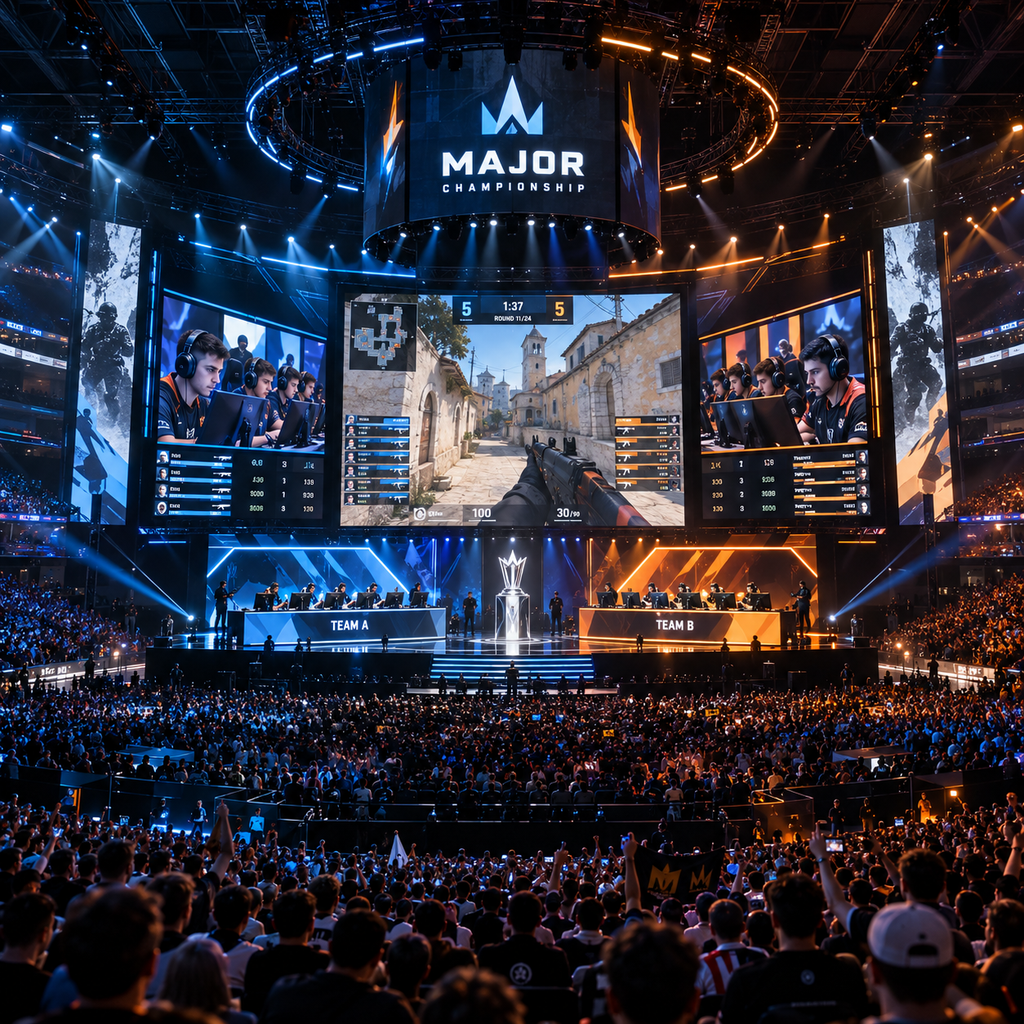
Two Majors occur annually with $1.25 million prize pools each, supplemented by Regional Major Rankings (RMR) events that distribute qualification slots.
The Major consists of three stages: Challengers (sixteen teams), Legends (sixteen teams advancing from Challengers), and Champions (eight teams in playoff bracket). Swiss system formats the opening rounds where teams play best-of-one matches until accumulating three wins or three losses. The Champions stage uses single-elimination best-of-three matches, culminating in a best-of-five grand final.
RMR tournaments distribute invitation slots through regional competitions across Europe, Americas, and Asia. Teams earn RMR points based on placement: first place awards 2,500 points, declining to 125 points for 16th place. The first CS2 Major in Copenhagen 2024 saw FaZe Clan claim victory with a 2-1 final victory over Natus Vincere.
The Dominance of Mobile Esports in Asia: New Industry Trends
Mobile gaming tournaments have achieved mainstream acceptance in Asian markets where smartphone adoption exceeds 90% in urban areas. PUBG Mobile Global Championship 2023 distributed $4 million across 48 teams from 28 countries, with Chinese squad Nova Esports claiming the $1.2 million first prize. Mobile Legends: Bang Bang World Championship (M5) offered $3 million, while Honor of Kings World Champion Cup reached $7.7 million.
Internet cafés remain the primary gaming venue in Southeast Asia, with mobile-optimized spaces outnumbering PC-focused establishments 3:1 in markets like Indonesia and Philippines. Tournament organizers leverage this by hosting offline qualifiers at shopping malls and mobile carrier stores, reducing travel barriers.
Upcoming gaming tournaments in the mobile sector increasingly adopt franchise models. Tencent Esports launched regional leagues for Honor of Kings with eight permanent partner teams per league. Average mobile esports match duration runs 18-22 minutes compared to 35-45 minutes for PC MOBAs, aligning with commuter viewing patterns.
Mobile tournament organizers generate 60-70% of revenue from in-game purchases tied to events, compared to 30-40% for PC tournaments. PUBG Mobile’s “Royale Pass” sells team-branded skins with 20% of revenue directed to participating organizations.
Franchise Leagues: Successful Models of Valorant Champions Tour and LEC
Riot Games revolutionized esports economics through franchise leagues that eliminate relegation and guarantee permanent partnership status. The League of Legends European Championship (LEC) launched in 2019 with ten partner teams paying €8 million entry fees. Valorant Champions Tour (VCT) followed in 2023 with thirty franchised teams across Americas, EMEA, Pacific, and China.
Financial stability represents the core franchise value proposition. Partnered organizations receive minimum revenue guarantees of $500,000-750,000 annually from league operations, supplemented by 50% revenue sharing on in-game cosmetic sales. This predictable income allows long-term roster planning impossible under promotion-relegation systems.
The LEC demonstrates franchise league maturation. Team valuations have appreciated 3-5x since 2019, with organizations like G2 Esports achieving $150-250 million enterprise values. Sponsorship deals have lengthened from one-year agreements to three-five year partnerships as brands gain confidence in perpetual league presence.
Evo (Evolution Championship Series): The Largest Fighting Game Tournament
Evolution Championship Series represents the fighting game community’s flagship event. Evo 2024 attracted 7,000+ registered competitors across nine titles including Street Fighter 6, Tekken 8, and Mortal Kombat 1. Unlike MOBA or FPS tournaments, Evo maintains grassroots roots where individual players pay $10-60 entry fees per game and compete in fully open brackets.
The tournament format uses double-elimination brackets that can span 1,024+ participants for popular titles. Early rounds occur simultaneously across hundreds of setups, with top-8 reaching the main stage. This scale demands volunteer judge networks and player-provided equipment for preliminary rounds.
Prize pools remain modest compared to MOBA tournaments: Street Fighter 6’s $50,000 and Tekken 8’s $30,000 represent top-tier distributions. The community prioritizes prestige over pure earnings, with Evo championship titles carrying career-defining weight. Winning Evo elevates players to sponsored professional status where endemic brands offer $30,000-100,000 annual salaries.
Intel Extreme Masters (IEM) and Iconic Arenas of World Esports
ESL Gaming’s Intel Extreme Masters constitutes the longest-running global esports circuit, having operated since 2006. IEM Katowice holds particular prestige as the unofficial “second Major” in Counter-Strike, annually filling the 11,000-seat Spodek Arena in Poland. The 2024 event distributed $1 million in prize money.
Tournament infrastructure standards reflect two decades of organizational evolution. ESL pioneered the double-elimination group stage format now standard across esports. The Intel partnership provides $100 million+ in cumulative sponsorship since 2006, funding consistent production quality.
Iconic venues define IEM’s cultural footprint. Spodek Arena in Katowice hosts 15,000+ fans annually with ticket prices ranging €40-150. Lanxess Arena in Cologne accommodates 17,000 for IEM Cologne, generating €8-12 million in local economic impact. These partnerships position esports alongside traditional sports in premier venues.
FAQ
What are gaming tournaments and how do they work?
Gaming tournaments are organized competitive video game events where players or teams compete for prizes, rankings, and prestige. They work through structured brackets—typically single or double elimination—where participants face off in matches with winners advancing until a champion emerges. Modern tournaments combine online qualifiers with offline finals, use seeding based on rankings, and feature group stages before playoff brackets.
How can I participate in free gaming tournaments for money?
Free gaming tournaments for money are accessible through multiple platforms. Many online casinos and gaming sites offer daily entry tournaments starting at $0.5 with prize pools reaching $2,500+. Platforms like BC.Game feature slot tournaments with low entry barriers and cashback bonuses up to 24%. Game-specific clients like Steam and console networks host official tournaments with free registration. Community platforms such as Battlefy and FACEIT list hundreds of weekly tournaments with no entry fees and prizes ranging $50-5,000.
What are the biggest upcoming gaming tournaments in 2026?
Upcoming gaming tournaments in 2026 include The International 14 scheduled for August in Copenhagen with an estimated $35-40 million prize pool, League of Legends World Championship 2026 in North America spanning October-November with $2.5 million guaranteed, and CS2 Majors in Rio de Janeiro and Shanghai at $1.25 million each. The BC.GAME World Cup 2026 offers over $2 million in rewards across multiple games. Mobile esports highlights include PUBG Mobile Global Championship 5 ($6 million expected) and Honor of Kings World Champion Cup ($8 million projected).
How much do professional gaming tournament players earn?
Professional gaming tournament players earn through multiple revenue streams. Top-tier players in Dota 2 and CS2 average $200,000-500,000 annually from tournament winnings alone. Salaried League of Legends franchise players earn $75,000-400,000 base salaries in major regions, plus tournament bonuses. Mobile esports professionals typically earn $30,000-150,000 annually. Additional income sources include streaming contracts, team salaries, sponsorships, and content creation revenue. Only the top 1-2% of competitive players sustain full-time careers.
Which gaming tournaments have the highest prize pools?
The International holds the all-time record at $40,018,195 for TI10 in 2021, followed by TI9 ($34,330,068) and TI8 ($25,532,177). Fortnite World Cup 2019 distributed $30,422,000 making it the highest single-season prize pool for a battle royale. PUBG Mobile Global Championship reached $6,000,000 in 2023. League of Legends Worlds maintains $2,250,000 base pools. CS2 Majors guarantee $1,250,000 twice annually.
Are online gaming tournaments legal in Turkey?
Esports tournaments are legal in Turkey and the country actively supports competitive gaming through government-recognized federations. The Turkish Esports Federation operates under the Youth and Sports Ministry, organizing national championships and international qualifiers. Turkey hosts regional qualifiers for major events including League of Worlds and CS2 Majors. However, gambling-related gaming tournaments face restrictions under Turkish gambling laws—platforms offering tournament play must comply with international licensing standards. Cryptocurrency-supported platforms like BC.Game operate under offshore licenses and are accessible to Turkish players.
What equipment do I need to compete in gaming tournaments?
Equipment requirements vary by game type and competition level. For PC tournaments, minimum specs include a gaming computer with dedicated GPU (RTX 3060 or equivalent), 144Hz monitor, mechanical keyboard, and gaming mouse. Console tournaments require the specific platform plus licensed controllers. Mobile tournaments need flagship smartphones released within two years with stable internet connections. Audio equipment must include noise-isolating headphones for LAN events. Most major tournaments provide standardized peripherals at venues.